I guess this will be a little briefer than usual, but I suppose everything now demands a response. Most of my own responses are intended to reveal some sort of perceived truth. However, my facebook experiences showed me that, if truth cannot be properly articulated in less than 100 words or so, I can indeed show everybody how witty I am. Of course, this invites others to show that, I may be witty, but I am seriously misinformed. This is properly referenced by a quick google check, and some well-placed sarcasm. As it turns out, my responses to each and every event – my need to have an opinion, is really not much more than wanting to feel vindicated in my world view, and feeling victorious. I like winning.
The reality is, however, that only elections seem to be won, and everyone else is suffering losses of dignity and respect. We want to win, and when we realize that the vast array of media outlets that give us more and more opportunity to share our voice serve just as well to show us how little meaning our voices have when presented within the context of opinion and self-validation instead of servanthood.
Of course, most opinions of late have to do with the death of bin Laden at the hands of special forces. Amazingly, or, perhaps not, is that now that the end has come for this individual, there is debate over whether people should cheer for his demise, or whether the killing was legal according to international law. There is also debate over the effectiveness of torture (enhanced interrogation) in gleaning information that may have potentially led to locating the “enemy of the state.” Obviously, every Quaker needs to have an informed opinion, not only about the reach of international law, but the legality of killing, and the poor taste indicated in torture.
Yet, certain questions remain. Do all the online arguments about the moral ambiguity of war and international conflict serve to provide clarity of our own beliefs, or do they exist to mock the intellectual shortcomings of our opponents. Quick wit and straw man attacks do not an argument make, a seminary ethics instructor assured me. I would drive him crazy by calling any theologian or ethicist I disagreed with a “hack.”
In fact, to speak about the morality of killing, whether it be an assassination, by bombing, in combat, or by flying airplanes into buildings, is somewhat moot if we are not changing our lives in a manner that reflects our willingness to step back from the nature of killing and reject the benefits we receive from it. It amazes me that pacifist would speak to the morality of lethal methodology and certain weaponry, when our own moral witness is that all violence is “bad” and that we should be “better” than that. It often seems to me that Friends are properly concerned with the plight of the oppressed, but rarely concerned with the plight of our opponents, and less concerned with the self-degradation that comes from our marginalization of those we see as a threat to our beliefs.
The notion that others might cheer for,an individual’s death may indeed offend our Quaker sensibilities. But arguing in a self-righteous manner that this is a poor exhibition of human nature are failing to accept folks where they are at, and how fear drives responses as much as a thirst for vengeance. More than one Friend has indicated verbally that they feel satisfaction when a politician is pointed out as having failings, though we rarely recognize our own. The other side cheers murder and accepts torture. We simply benefit from it, and I will personally be the first to admit I have the high ground. Pass me the car keys, please, and give me more stuff. I hate torture, and murder and drones make me uncomfortable. Let’s write a minute to indicate to other Friends that we are as indignant as they are.
Showing posts with label sacrifice. Show all posts
Showing posts with label sacrifice. Show all posts
Saturday, May 7, 2011


Saturday, September 18, 2010

Friday, December 11, 2009
Reflections on Barak Obama's Nobel Address
After reading Barak Obama’s address to the Nobel Prize community, I am left wondering what a unified Quaker response might look like. I wonder about the response, because of the numbers of Friends that I can imagine who voted for him. I wonder about what that response may look like, because I am a firm believer in a public witness that entails actions, and not just words. All I can share with those of you who have chosen to read this posting, however, are the thoughts of one Friend.
It is my assumption that Barak Obama is a person of integrity. During the election, and during his first year in office, I have been shown no reason to think otherwise. I believe he was humbled by the Nobel award he just received. I also believe he thinks it perhaps minimally justified by his morally obligatory stand against torture of enemies at the hands of the United States and its client-countries, his willingness to take a stand against an unwarranted invasion of a sovereign nation by the United States, and his willingness to engage in dialogue with those nations who were once labeled as, or held in the same esteem as, those states deemed “The Axis of Evil.” Indeed, during his speech, he highlighted these differences between the former administration and his own. A close friend of mine told me he firmly believed that Barak Obama deserved the award because of just such circumstances.
While I admit that there are some major differences between this administration and the last, when it come down to the finer points of the American government and its capacity to wage war, it seems to me that Barak Obama and other American presidents from both parties are cut from the same cloth. (I was immediately alarmed when Obama pulled out the tired example of Nazism and labeled his enemies as “evil”) That being, that the United States will not only protect its own interests, but will flex military muscle in order to protect a standard of living here at home, and export the values of quasi free-market liberal democracies to those nations whom might otherwise be offended by those values.
Yet, if Barak Obama is the man of integrity that many of us believe he is, then he must at some deep level believe in the concept of just war and the primacy of liberal democratic values as the primary vehicle for the expansion of just societies - not just the marketplace. After reading his address, it is of my opinion that, as a man of integrity, Barak Obama has issued a challenge to pacifist Friends, who post a belief that coercive force can never be justified. I propose that Barak Obama went to great lengths to justify the use of force, and to properly place the responsibility of using such force squarely on the shoulders of “the world’s sole military superpower.” Not only that, he properly called for other responsible nations to share in the cause of this “just war” against terrorism.
I say this because, when a person of integrity, no matter where he or she is from, digs deeply into themselves and struggles with the example of Martin Luther King Jr. and Gandhi, then still comes to believe that as the person bearing the responsibility for action he or she must act with force - It can be stated they are making reasonable, moral decisions. I say moral, because it may be rightly assumed that coercive force and military action may be deemed morally appropriate when matters of justice, equality, and the often unbalanced scales of peace are in question. More importantly, it might be appropriate when innocent human lives are at stake.
As a Christ-centered participant in the Religious Society of Friends, however, I believe that myself and others must respond in a quite different manner than other reasonable persons of integrity may feel obligated to respond. I must, however, make one point that is significant to my own proposal. I fully understand all of the political and moral arguments for and against the use of military and coercive force as a means to a just end. I am in disagreement with the proposal leveled by Barak Obama and so many others that a war can be considered just. However, it would be just as wrong for me to exclude militarists from dialogue as it would be for me to exclude a religious fundamentalist or non-theist from dialogue concerning properly displayed religiosity or tenets of theology. In a world where the most moral actions are often facilitated by introspection, all must have a place at the table because of the injustices or privilege that may have brought them to their view of reality, clouded or otherwise.
As one Quaker whose perspective fits somewhere along a spectrum of Quakerisms, I will state that Barak Obama has made an intellectually sound and reasonable decision to carry out his purpose in Afghanistan. I can differ with Obama, or George Bush, or any other president on the manner of action which they order to be carried out, but arguments made from political or abstract moral considerations are always debatable. Indeed, if many Friends are willing to say that there is no possibility of knowing a spiritual Truth, they must agree that all Truth is relative, including political truth. As such, a morally justified case for war can be made just as easily and intellectually as can the moral case against it. For years Friends have spent much time and money on persuading militarists of the impropriety of their assumption about coercion and war, without providing any example of an alternative. Ridding the world of cluster bombs may be a worthwhile idea, but it is far from an alternative to war.
The world still works under the assumption that justice can only be ensured through the threat of force. It may safely be said that such justice is always the justice of those in power who can make good on the threat of force. This is as true of political liberals as of conservatives. Whether by tanks or ballot boxes, legal use of coercion rules at the end of the day.
Much of the pacifism practiced in the United States is a pacifism of privilege, where Friends and Mennonites and many others state they are against the use of force while taking advantage of all the benefits bestowed upon them by the fact of the military and economic superpower status of the American Empire. As such, the question remains, what are Friends offering as an alternative to Barak Obama’s preferred means to reaching a just end? In the end, troop withdrawals and conversations with moderate Taliban leaders may sound good, but Afghanistan is not going to be pacified, or find justice in any of the actions that Democrats or Republicans may propose. It will certainly never find a justice that meets the United States’ vision of justice. The values of liberal democracy only play well in Peoria or Paris. They do not play well in Kabul. And, they will not last without the threat of American military action, just as opponents of the debacle in Iraq have been saying for years. As such, you can pull out all the troops, but will that meet Barak Obama’s standard of justice? He has called this an action against evil, and how does a person of integrity walk away from a battle with evil?
Quakers must offer an alternative. A community of peace that lives, not in a state of political pathology, but of a peace that is formed by the story of our souls. We must be a people of peace because we can be no other way, but instead are part of a story that realizes that it is war that is evil, not combatants, and that we act justly by serving both our neighbors and enemies without distinction. Even if our enemies are labeled conservatives.
The idea of martyrdom has long passed for most Christians, but the example of Tom Fox looms large, or should loom large, in our collective Quaker psyche. When asking the rest of the world to find peace, we must be living lives that act out such a peace on a daily basis, not only pointing out the injustices leveled against the innocent by our own government as well as others, but by refusing to participate in the privileges of living within the heart of the empire. Much of what has passed for peace and justice work in the United States has been about bringing marginalized Americans into their proper place as fellow exploiters of the world’s resources. Much of the freedom that Americans try to export is the freedom for others to consume on the same level as American citizens enjoy. Now is the time for Friends to be truly plain, and truly equal.
I propose voluntary self-sacrifice, not in the manner of Tom Fox per-se, but in the manner of Jesus as recorded in the Greek Testament, and that proposed by Paul’s letter to the churches of Rome and Phillipi. Jesus, who emptied himself of privilege and lived a life that provided an example for others, and Paul, who exhorted messianics in Rome to present themselves to the God of Peace “as a living sacrifice.” Both lived the life of non-violence, as did Gandhi and Martin Luther King Jr. centuries afterwards. Both counted on alternative economics as the means to reflect the justice of God. Both spoke out against the assumptions of empire. And both, as did so many others who have sought justice, went on living out an example of justice that excluded violence and privilege. And, all did so on the basis of a Truth that non-violence is the desire of a God who makes it to rain on both the just and the unjust. Such should be the example of Quaker communities.
I do not know if such an example will end war. I do know that much of the world has forgotten what peace and justice really look like, and sorely needs such a reminder. We are a muddled race of beings, beset by the sin of our fathers and ourselves. We can never legislate peace, and we have never legislated a just means of fighting just wars. It is time that our efforts turn away from legislation and elections, and more toward the formation of alternative Quaker communities that live in a manner that suggest peace is possible, if only in as much as we ourselves are able.
It is my assumption that Barak Obama is a person of integrity. During the election, and during his first year in office, I have been shown no reason to think otherwise. I believe he was humbled by the Nobel award he just received. I also believe he thinks it perhaps minimally justified by his morally obligatory stand against torture of enemies at the hands of the United States and its client-countries, his willingness to take a stand against an unwarranted invasion of a sovereign nation by the United States, and his willingness to engage in dialogue with those nations who were once labeled as, or held in the same esteem as, those states deemed “The Axis of Evil.” Indeed, during his speech, he highlighted these differences between the former administration and his own. A close friend of mine told me he firmly believed that Barak Obama deserved the award because of just such circumstances.
While I admit that there are some major differences between this administration and the last, when it come down to the finer points of the American government and its capacity to wage war, it seems to me that Barak Obama and other American presidents from both parties are cut from the same cloth. (I was immediately alarmed when Obama pulled out the tired example of Nazism and labeled his enemies as “evil”) That being, that the United States will not only protect its own interests, but will flex military muscle in order to protect a standard of living here at home, and export the values of quasi free-market liberal democracies to those nations whom might otherwise be offended by those values.
Yet, if Barak Obama is the man of integrity that many of us believe he is, then he must at some deep level believe in the concept of just war and the primacy of liberal democratic values as the primary vehicle for the expansion of just societies - not just the marketplace. After reading his address, it is of my opinion that, as a man of integrity, Barak Obama has issued a challenge to pacifist Friends, who post a belief that coercive force can never be justified. I propose that Barak Obama went to great lengths to justify the use of force, and to properly place the responsibility of using such force squarely on the shoulders of “the world’s sole military superpower.” Not only that, he properly called for other responsible nations to share in the cause of this “just war” against terrorism.
I say this because, when a person of integrity, no matter where he or she is from, digs deeply into themselves and struggles with the example of Martin Luther King Jr. and Gandhi, then still comes to believe that as the person bearing the responsibility for action he or she must act with force - It can be stated they are making reasonable, moral decisions. I say moral, because it may be rightly assumed that coercive force and military action may be deemed morally appropriate when matters of justice, equality, and the often unbalanced scales of peace are in question. More importantly, it might be appropriate when innocent human lives are at stake.
As a Christ-centered participant in the Religious Society of Friends, however, I believe that myself and others must respond in a quite different manner than other reasonable persons of integrity may feel obligated to respond. I must, however, make one point that is significant to my own proposal. I fully understand all of the political and moral arguments for and against the use of military and coercive force as a means to a just end. I am in disagreement with the proposal leveled by Barak Obama and so many others that a war can be considered just. However, it would be just as wrong for me to exclude militarists from dialogue as it would be for me to exclude a religious fundamentalist or non-theist from dialogue concerning properly displayed religiosity or tenets of theology. In a world where the most moral actions are often facilitated by introspection, all must have a place at the table because of the injustices or privilege that may have brought them to their view of reality, clouded or otherwise.
As one Quaker whose perspective fits somewhere along a spectrum of Quakerisms, I will state that Barak Obama has made an intellectually sound and reasonable decision to carry out his purpose in Afghanistan. I can differ with Obama, or George Bush, or any other president on the manner of action which they order to be carried out, but arguments made from political or abstract moral considerations are always debatable. Indeed, if many Friends are willing to say that there is no possibility of knowing a spiritual Truth, they must agree that all Truth is relative, including political truth. As such, a morally justified case for war can be made just as easily and intellectually as can the moral case against it. For years Friends have spent much time and money on persuading militarists of the impropriety of their assumption about coercion and war, without providing any example of an alternative. Ridding the world of cluster bombs may be a worthwhile idea, but it is far from an alternative to war.
The world still works under the assumption that justice can only be ensured through the threat of force. It may safely be said that such justice is always the justice of those in power who can make good on the threat of force. This is as true of political liberals as of conservatives. Whether by tanks or ballot boxes, legal use of coercion rules at the end of the day.
Much of the pacifism practiced in the United States is a pacifism of privilege, where Friends and Mennonites and many others state they are against the use of force while taking advantage of all the benefits bestowed upon them by the fact of the military and economic superpower status of the American Empire. As such, the question remains, what are Friends offering as an alternative to Barak Obama’s preferred means to reaching a just end? In the end, troop withdrawals and conversations with moderate Taliban leaders may sound good, but Afghanistan is not going to be pacified, or find justice in any of the actions that Democrats or Republicans may propose. It will certainly never find a justice that meets the United States’ vision of justice. The values of liberal democracy only play well in Peoria or Paris. They do not play well in Kabul. And, they will not last without the threat of American military action, just as opponents of the debacle in Iraq have been saying for years. As such, you can pull out all the troops, but will that meet Barak Obama’s standard of justice? He has called this an action against evil, and how does a person of integrity walk away from a battle with evil?
Quakers must offer an alternative. A community of peace that lives, not in a state of political pathology, but of a peace that is formed by the story of our souls. We must be a people of peace because we can be no other way, but instead are part of a story that realizes that it is war that is evil, not combatants, and that we act justly by serving both our neighbors and enemies without distinction. Even if our enemies are labeled conservatives.
The idea of martyrdom has long passed for most Christians, but the example of Tom Fox looms large, or should loom large, in our collective Quaker psyche. When asking the rest of the world to find peace, we must be living lives that act out such a peace on a daily basis, not only pointing out the injustices leveled against the innocent by our own government as well as others, but by refusing to participate in the privileges of living within the heart of the empire. Much of what has passed for peace and justice work in the United States has been about bringing marginalized Americans into their proper place as fellow exploiters of the world’s resources. Much of the freedom that Americans try to export is the freedom for others to consume on the same level as American citizens enjoy. Now is the time for Friends to be truly plain, and truly equal.
I propose voluntary self-sacrifice, not in the manner of Tom Fox per-se, but in the manner of Jesus as recorded in the Greek Testament, and that proposed by Paul’s letter to the churches of Rome and Phillipi. Jesus, who emptied himself of privilege and lived a life that provided an example for others, and Paul, who exhorted messianics in Rome to present themselves to the God of Peace “as a living sacrifice.” Both lived the life of non-violence, as did Gandhi and Martin Luther King Jr. centuries afterwards. Both counted on alternative economics as the means to reflect the justice of God. Both spoke out against the assumptions of empire. And both, as did so many others who have sought justice, went on living out an example of justice that excluded violence and privilege. And, all did so on the basis of a Truth that non-violence is the desire of a God who makes it to rain on both the just and the unjust. Such should be the example of Quaker communities.
I do not know if such an example will end war. I do know that much of the world has forgotten what peace and justice really look like, and sorely needs such a reminder. We are a muddled race of beings, beset by the sin of our fathers and ourselves. We can never legislate peace, and we have never legislated a just means of fighting just wars. It is time that our efforts turn away from legislation and elections, and more toward the formation of alternative Quaker communities that live in a manner that suggest peace is possible, if only in as much as we ourselves are able.
Friday, July 6, 2007
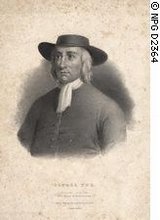
Thinking of John Woolman
This song is written by a band called Temple of the Dog, and it is called Hunger Strike
For a variety of reasons, it brings to mind the integrity of John Woolman. While I am very aware that Woolman would never steal food from anyone, this song nevertheless captures the struggles of Friends trying to live lives of justice in the midst of unjust and exploitative economies. Whether we are products of the18th century, or 21st century, faithful living requires sacrifice.
I don't mind Stealing Bread From the mouths of decadence...
But I can't feed on the powerless When my cup's already overfilled
But it's on the table, The fire's cooking
And they're farming babies, and the slaves are all working...
Blood is on the table,the mouths are chokin'...
I'm goin' hungry...
I don't mind Stealing Bread From the mouths of decadence...
But I can't feed on the powerless When my cup's already overfilled
But it's on the table, The fire's cooking
And they're starving babies, And the slaves are all working...
And it's on the table,The mouths are choking...
I'm going hungry...
For a variety of reasons, it brings to mind the integrity of John Woolman. While I am very aware that Woolman would never steal food from anyone, this song nevertheless captures the struggles of Friends trying to live lives of justice in the midst of unjust and exploitative economies. Whether we are products of the18th century, or 21st century, faithful living requires sacrifice.
I don't mind Stealing Bread From the mouths of decadence...
But I can't feed on the powerless When my cup's already overfilled
But it's on the table, The fire's cooking
And they're farming babies, and the slaves are all working...
Blood is on the table,the mouths are chokin'...
I'm goin' hungry...
I don't mind Stealing Bread From the mouths of decadence...
But I can't feed on the powerless When my cup's already overfilled
But it's on the table, The fire's cooking
And they're starving babies, And the slaves are all working...
And it's on the table,The mouths are choking...
I'm going hungry...
Tuesday, June 12, 2007
theology of suffering?
I've been thinking about the place of self-sacrifice and suffering in Quakerism, and I'd like to share some of those thoughts. Early Friends sacrificed a great deal in terms of personal liberty, economic stability, and their physical safety and well-being. If you wanted to be a Friend in the mid 17th century, it was going to cost you. We have all heard or read the stories of the brutal oppression of those who called themselves Friends.
Yet, similarly to Anabaptist thinking, Friends may have expected the persecution because they knew that the darkness would persecute God's "Children of the Light." Of course the Quakers of the past participated in the legal process to try and end persecution, whereas Mennonites did not, but few Friends of that era express surprised that they were being attacked violently, legally and theologically by most of their contemporaries.
I believe that those Friends remained faithful despite the persecution because they knew in their souls that they were being obedient to the very Christ within, or the will of God as expressed through the Light of Christ. Once one was privy to such religious truth, one became willing to suffer in order to remain faithful to the truth. In fact, one went on specific missions to preach the truth in spite of the suffering that would result. George Fox held a Meeting for Worship in prison while he was at liberty after the 2nd Conventicles Act, lamenting that he hated prison meetings because if he was going to be arrested, he'd rather it happen in public.
Without such sacrifice, which I believe is an integral part of the Christian-Quaker spiritual narrative, there would be no community of truth with the willingness to offer real alternatives to the violence of empire, economies, and cultures. However, the very suggestion that suffering is a necessary aspect of any spiritual truth is unquestionably dangerous. Haven't enough women, slaves, and oppressed peoples everywhere been told that suffering is the proper response to sexism, injustice and powerlessness. How many housewives have suffered through abusive relationships for the "good of the marriage" or the "sake of the children?" How many victims of empire were told that part of their colonized status was to accept their new Christian role as servants to their masters?
In light of this truth about the way theologies of sacrifice have been used to inflict suffering upon those the church was intended to liberate, how can I ask others to sustain such a spiritual path. I believe, first, that self-sacrifice or suffering must be intentional. It must by well founded in healthy emotional and psychological states, by persons who are not already victims of oppression. Secondly, such intentional sacrifice and suffering must be borne by communities, and not individuals. Without communities of peace that are intent on liberating others from bondage to church or state (or enlightenment rationality or the current relativism), individuals will suffer alone, and that is a state of being that cries out injustice. But, sacrifice we must, if we are to leave a legacy that grows into a strong public witness for peace. If we sacrifice together, as communities of faith, we might suffer, but we will suffer with dignity. Remember, God works through us when we are weakest, when we are most Creator-reliant and committed in our faith.
Yet, similarly to Anabaptist thinking, Friends may have expected the persecution because they knew that the darkness would persecute God's "Children of the Light." Of course the Quakers of the past participated in the legal process to try and end persecution, whereas Mennonites did not, but few Friends of that era express surprised that they were being attacked violently, legally and theologically by most of their contemporaries.
I believe that those Friends remained faithful despite the persecution because they knew in their souls that they were being obedient to the very Christ within, or the will of God as expressed through the Light of Christ. Once one was privy to such religious truth, one became willing to suffer in order to remain faithful to the truth. In fact, one went on specific missions to preach the truth in spite of the suffering that would result. George Fox held a Meeting for Worship in prison while he was at liberty after the 2nd Conventicles Act, lamenting that he hated prison meetings because if he was going to be arrested, he'd rather it happen in public.
Without such sacrifice, which I believe is an integral part of the Christian-Quaker spiritual narrative, there would be no community of truth with the willingness to offer real alternatives to the violence of empire, economies, and cultures. However, the very suggestion that suffering is a necessary aspect of any spiritual truth is unquestionably dangerous. Haven't enough women, slaves, and oppressed peoples everywhere been told that suffering is the proper response to sexism, injustice and powerlessness. How many housewives have suffered through abusive relationships for the "good of the marriage" or the "sake of the children?" How many victims of empire were told that part of their colonized status was to accept their new Christian role as servants to their masters?
In light of this truth about the way theologies of sacrifice have been used to inflict suffering upon those the church was intended to liberate, how can I ask others to sustain such a spiritual path. I believe, first, that self-sacrifice or suffering must be intentional. It must by well founded in healthy emotional and psychological states, by persons who are not already victims of oppression. Secondly, such intentional sacrifice and suffering must be borne by communities, and not individuals. Without communities of peace that are intent on liberating others from bondage to church or state (or enlightenment rationality or the current relativism), individuals will suffer alone, and that is a state of being that cries out injustice. But, sacrifice we must, if we are to leave a legacy that grows into a strong public witness for peace. If we sacrifice together, as communities of faith, we might suffer, but we will suffer with dignity. Remember, God works through us when we are weakest, when we are most Creator-reliant and committed in our faith.
Subscribe to:
Posts (Atom)