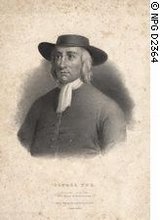
A Quaker who fancies himself a prophet lay in bed next to his wife, waiting on a word from God. YHWH El Shaddai comes to him and quietly asks, “what would you pray for, scot?” I am afraid to answer, for even I am afraid to lie to YHWH. “But, I am not concerned that you may lie to me,” says the Holy One. “I am more concerned that you might lie to yourself. What will you pray for?”
Must I be honest? God knows what I would pray for, which is generally why I don’t pray. I just wait, hoping that the Spirit will never move me to confront myself. “If I were to pray honestly, I could ask for no more than to do God’s work, and enjoy stability for myself and my family.”
“What is it you want to pray for,” I am asked. I answer: “I want to be able to pray that the desire of YHWH is carried out by those who confess.” The next question is obvious. “Why don’t you pray for that desire to be met ?” I do not hesitate to respond. “It may mean that I might have to sacrifice in ways that I am not wanting to sacrifice. You have brought me a long way, YHWH. It seems as though now, I have something to lose.”
“What is it that you have faith in, then, if not the potential for my desire to meet your every need?”
What does faith mean, I ask, to one who has a house, and livestock, a wife and children who love me. I have a lofty job with an opportunity to reveal some sort of truth, to impactthe faith of others. Why should I have faith in digging ditches while drunk. I am tired of growth. I want to pray for myself, that I might finally be stable. That I might be able to settle.
“You need to read the Book more,” is the response that I feel. Centuries of revelation can not be dismissed by the untested experience of one junkie or religious refugee. The act of rejecting the revelation of the ancients does not make one exponentially more suited for the Truths of the future. It simply means that you might be spit out a spaceship instead of a big fish.
Either way, it will be a hot day in the desert when it’s all said and done, and nothing that begins in the desert seems to end well. Only the pure, it seems, enjoy the happy endings. As a particularly attentive person once said, “Hey… It’s not all about you, Job.”
Showing posts with label faith. Show all posts
Showing posts with label faith. Show all posts
Friday, October 1, 2010


Saturday, September 18, 2010

Saturday, August 21, 2010
A few thoughts on theodicy
"I've also been struggling with Theodicy, the problem of suffering. I imagine that is something that you have studied before. Do you have any insights? These questions have really pushed me to examine and change some of my beliefs." A Query from a Friend
Boy, this is like the first question everyone asks in seminary or philosophy courses. One kind of person gives up on getting a good answer, and another kind of person writes a book about it. Half of those books suggest that there is no answer to the question of theodicy, and the other half quit on god, or turn to Nietzsche (Ubermann!!!)
Really, I think that the question of theodicy mostly baffles persons such as those that often find their way to Quaker meetings. We are a people who are looking for a pure place to stand in life, and when we realize how frustrating it is that we cannot find such a place, we become frustrated with the possibility that perhaps God or the gods may not be so pure as we would like them to be. This might sum the Hebrew Scriptures in a nutshell, which is a perhaps far more realistic portrait of deity than the Greek/Christian expectations of literal supernatural perfection. Did the Hebrews understand life to be tough, unfair, and violent, and that it is the innocent who are most prone to suffering?
Indeed, when your experience of life is such that you cry out to your god that the heads of your enemy's infants might be dashed against the rocks (Psalm 137), you most likely attribute some fairly ferocious if not schizophrenic attributes to the deity that is also representative of grace, forgiveness, mercy and lovingkindness. So, when Jesus comes along and says YHWH is full of love, we desperately need YHWH be loving in a way that rises above the impurities of our existence, and meets exactly those standards that we ourselves attribute to God. But certainly we must ask, is love pure?
My answer to theodicy, for what it's worth, is that when Eve (remember the story?) bites into the fruit of knowledge, we should really be referring to the event as the "blessing" of sin. Think of relationships, and what makes them worthwhile. Perhaps the challenge of making them work is enticing, and so is the physical intimacy that is often enjoyed, ranging from infant-mother touching to healthy adult sexuality. However, if we engaged in "relationship" without the ability to choose whether we wanted to respond to the “other” (whether comrade, lover, or cosmic force) with real and uncoerced or manipulated love, and without the knowledge that the "other" was freely choosing to love us, there would be no relationship, and we would never experience emotional or spiritual growth, let alone real love.
If a divine entity wants to engage in real relationship with humanity, then not only is the capacity of the created being to freely choose participation absolutely necessary for healthy relationship (which, by the way, benefits the deity as well as the creature), but the ability of the deity to restrain the divine-self from interfering with the creature's free will, and accept the (logical?) necessity of showing restraint in mandating outcomes as opposed to responding to human activity is of primary philosophical importance. I suggest that the only “answer” to evil and suffering is to eliminate the opportunity for emotional and spiritual maturation. It's a catch-22...If you don't experience surd evil and human evil, there is no potential for growth, and certainly no possibility of joy. It would be a life void of climax. If a divine entity does away with the possibility of evil and suffering, neither the creature nor the creator can possibly experience growth, and, more importantly, both are rendered incapable of relationship because of an insistence on purity.
So, the question I ask is: What is the most appropriate sacrifice in a religious context? Is humanity a colossal mistake, and humankind must assuredly sacrifice the narratives of the gods in order to understand the necessity of championing reason and utility over the lure of mythical cadence? Would the earth be better off without us in order that there be no human suffering? The latter question could be answered affirmatively, as at least we could not continue the present rate of ecological degradation that we seem bent upon. The former query, however, teeters on the brink of unintelligibility in the modern context of supremacy of the individual, as we might see humanity as a mistake in general, with perhaps the caveat that one might rather enjoy his or her own privileged existence.
Because I believe there is no ultimately reasonable, or at least quasi-empirical, answer to the question of suffering, we must view the facts of our existence, which are apparently randomness, violence, and meaninglessness, through the lens of religion. Corporate expressions of faith provide for meaning, and for an ongoing human narrative in which we might choose to participate in a manner that recognizes our potential for experiencing love and joy in spite of the truth of suffering. Thus, we have theology, which provides a sense of unity and intelligibility to our spiritual experiences of meaning and wholeness.
Facts, my friends, are meaningless without conversion experiences which allow for interpretation of facts (to paraphrase Foucault) and an opportunity to realize truths. Those experiences are not necessarily religious, but are almost entirely spiritual or philosophical in nature. Such spiritual or constitutional experiences of metanoia generally require a relationship with a deity, or at the very least, a community of privileged interpreters no matter how imperfect such corporate authorities might seem to be.
Saturday, July 17, 2010
Some thoughts on ethics
The stories we tell to one another reveal much about who we are, and what we believe. In my family, the children love to hear stories of how mom and dad met, or the ice storm that was occurring when mom went into labor with Micah. With Emma, we didn’t even own a car, and relied on neighbors to drive us 15 miles to the hospital. Such stories, which are similar to those narratives told by most families, not only keep our children or friends amused. Stories of our lives are integral pieces of identity formation. Not only do they reveal much about us to others, they provide a foundation for who we believe we are as individuals, as members of families, and as participants in community.
Interestingly, the stories we tell one another within the context of family or community often indicate the social and kinship roles that we are expected to maintain as individuals. Not only do the stories we tell about dad tell us what kind of person he is or was, but also indicate the kind of character expected from males in the family. Stories about early American heroes not only serve to bring us together as Americans, but indicate the type of individual character that best serves the interests of the overarching American themes of individualism, exceptionalism, and overachievement.
Such themes are not strictly conservative political or liberal social values in the United States. Stories we tell about the American independence movement or the Underground Railroad, the two World Wars or the Civil rights movement of the 50’s and 60’s, are seminal, not only to how we view ourselves as Americans, and the roles we are expected to master as American citizens, but how we measure ourselves individually against our political and religious opponents. We are a story-formed people, and, perhaps, a story-formed race of created beings. We use stories, not always as a fully fact-checked facsimile of truth, but as indicators, reflections, and re-enforcers of truth. And, like any language game, we use stories to harness the reigns of power, and legitimate our claims that we possess the knowledge of truth and the right to express it.
For much of history, stories that were once oral in nature have been codified into standard texts. Indeed, the first thing that humans do at this point in history is codify truth in the form of constitutions, contracts, rule books, and other projects of human reasoning designed to take the element of the supposed fallibility of oral presentations out of the process of human progress. If the Enlightenment, and its grandchild modernity insist on anything, it is that we must no longer allow stories to encumber us with continuity of identity, or chain us to the misleading ministrations of mythology. Stories, suggest the empiricist, are the bane of human liberation and individual freedom. Reason is the liberator of humanity, goes the argument against maintaining the ethics of the past, whether they be underwritten by religion, ancient philosophy, or even, the particular ethics of ethnic, racial, or economic experience.
You might be raising the question at this point, what does this have to do with Quakerism? I suggest that the tensions that exist between story and reason, and between past and future, and that place in between in which Quakerism should serve to mediate, have been eliminated. Reason marginalizes the stories of our beginnings, the historical nature of our moral authority, and the concept of cultural continuity. Our future is open for consumption, without the burden of the limits of ancient values, texts, or gods. We can choose our identities in America, shopping around for the right fashion, fantasy, political cause or spiritual truth that appeals to us as individuals, and serves to comfort our self-marginalizing tendencies by legitimizing the supremacy of choice.
I contend, however, that ethics should not be a matter of choice. Before you become too upset or puzzled, I will quickly explain what I do not mean. No one should be forced to practice any religion, and there should be no mandate that we become Lutheran, Baptist, Sunni, or Orthodox Jew. I do not mean that we should legislate school prayer, or that the political wishes of a faith community be codified into secular law so that there can be no gay marriage or divorce. I do not seek political legitimization of any faith, nor do I suggest that religious codes trump democratically derived legal codes within the context of our society. I am a firm believer in self-determination, and believe that the participation in any group, religious or otherwise, be voluntary.
However, I contend that faith itself, the foundation of what we come together for on First Days, is not a matter of choice. Faith, and faithfulness, is a matter of experience, discernment, and praxis, or, the practice of living out of a belief. I contend that our experience of the divine crosses the line that demarcates the distance between story and reason. For those who have experienced the risen Christ, this means that we no longer choose our identity, but assume the identity of a chosen people. As Paul says, “we are no longer our own.” As the author of First Peter writes, we are “a peculiar people.” God’s own possession. As such, when it comes to discerning community morals and the ethics that place those values on public display, we are a people of the Book, and not necessarily a people of reason.
There is a challenge of unlimited scope that becomes evident when one assumes the ethic of a religious narrative that claims to be an alternative to the supremacy of reason. Primarily, at least in the western world, we are forced to make a choice that exists in that tension I mentioned before. In order to be taken seriously as a community, and in order to have our faith legitimated, we feel we must compete in the marketplace of pragmatics in order to fully participate in our democracy. Yet there is another aspect of the challenges of reason that compete with faithfulness. That is the challenge of economic and political power. In the pursuit of both, the people of God have often chose to manipulate the ethics of the Yahwist story and marginalize the life of Jesus as the primary informants of our identity. We instead choose to pursue power in a political manner that ignores the reality of the cross, and according to an economic ethic that ignores the manner of life which Jesus lived. I believe that, in America, we have become a people whose faith and practice is legitimized by the nation state, and who view the nation state and liberal democracy as the primary means of continuing the work of God.
However, the only legitimization necessary to a community of faith is the evidence of a corporate life that reflects their faith, and prioritizes the truth of Jesus of Nazareth over the power of nation states as a means of garnering justice. The key component to living such a life of faith is the characteristic of patience. Just as Jesus’ faithfulness was vindicated by the resurrection, so shall the faithful community be vindicated by God. Faithfulness exhibits the trust that God will act in the future, and that those actions will justify those believers who chose to live without the advantage of identity surfing. One example of such faithfulness exists in the midst of the Holocaust. It is the story of a Huguenot community in occupied France.
During the occupation, very few French nationals served the organized resistance. The realities of World War I and the failure of the impenetrable Maginot Line had demoralized many of the citizens. Many French simply complied with Nazi rule, including participation in the destruction of the Jewish and other marginalized populations. However, in a town called Le Chambron, more than 6000 Jews were saved from Nazi imprisonment and worse, because there were people who considered themselves citizens of the Kingdom of God, and thus not bound to serve military or elected authority simply because of potential consequences. Academic Philip Haillie wrote in 1981 that many French citizens not only collaborated with the German occupiers, but tried to outdo them in anti-Semitism in order to maintain good relationships with their conquerors. Hallie, an American Jew, wrote that the French Protestant village, surrounded by a nation of nominal Catholics and humanitsts, were different. They were different he wrote, because he perceived that they had no choice in the matter of helping Jews escape certain death. The read the Bible, and they took it seriously. In fact, Hallie wrote, “They believed it… they were literal fundamentalists.”
Now there is a catchphrase. Fundamentalists. However, fundamentalism in the context of Christianity, does not regard literalism as any more than an aspect of certain fundamentals of faith. Literalism itself, or belief in the story, can be separated from fundamentalism, which is more of an American political movement and fairly uncomfortably developed relationship between western reason and biblical faith. For instance, many fundamentalists will concern themselves with biblical values that reinforce common social themes of patriarchy, homophobia, and heaven as the primary expression of social justice. Yet, fundamentalism does not do justice to the biblical story, or the story of Jesus, or the ability of a community to believe that the Holy Spirit can guide a community to interpret the authoritative texts in a faithful manner that bears fruit in a manner that is different from another community. Fundamentalism does not have the patience to wait for divine vindication, and has thus chosen political power to establish a semblance of God’s perceived will in dominance over the rest of an unbelieving society.
Yet, the story of God, the biblical account of Jesus’ life, the reality of the cross, and the resurrection, point to a different ethic, and this ethic flies the face of reason when given the same weight on the cosmic scales of community praxis. The story of God’s chosen people is a narrative in which God has offered salvation to humanity through the developing of relationship between Creator and creation. The life lived by Jesus welcomed the world into a covenant that was established with Abraham and Sarah, with Hannah, Ruth, and David, and with all Israel. This covenant trusts that God will act faithfully, and enjoys a faithful response to the divine expression of love. Faithfulness means an expression of love toward the Creator, and toward one another whether neighbor or enemy. And if we believe in the supremacy of Jesus’ ethic of love as the expression of God’s truth, we have no choice when it come to protecting the oppressed, inviting the marginalized into our homes, and pursuing justice.
Wwe also have no choice in the question of violence. This, my Friends, is giving literal meaning to the whole of a text, and not only shoe-horned proof-texts that underwrite homophobia and other aberrations of God’s desire. Indeed, as Quakers, we should have no choice in the question of political power. If we are faithful to the story of Jesus, we sacrifice ourselves voluntarily so that we, as a people, can reflect the desire of God for the faithfulness of humanity. A desire that is shown fully in the life and voluntary sacrifice of Jesus the Messiah.
Jesus’ life showed very little regard for empirically developed and fully reasoned ethics. Jesus simply displayed an ethic of love and faithfulness. It was an ethic of justice, and egalitarian community - of welcoming in those who repented and maintaining faithfulness in the face of persecution. Jesus was a literalist, not in the sense of Torah as a means of controlling communities as maintaining hierarchies, but as a man who believed that God existed in a literal sense, and could be trusted to be faithful to those communities who identified themselves as a possession of God, and not persons free to choose amongst ethics of other nations that would make them relevant to the politics at hand. The life Jesus is an invitation to participate in the people of God, not a coercive historical act that mandates God’s will be executed by human institutions through forced baptisms, crusades, state churches or ballot boxes.
The people of God experience God’s love, and believe the attending ethic is revealed through Jesus, then voluntarily join a community that reflects God’s love because they do not consider alternatives to love as a viable option. There is not always reason in a nonviolent ethic. There is not always reason voluntary sacrifice, whether it be on a cross, or refusing to sacrifice to Caesar, or refusing to baptize infants. There is not always reason when followers of Jesus involuntarily sacrificed in the manner of the Underground Railroad, or refusing to defend personal property in the manner of Mennonites and many Quakers during the Revolutionary and Civil Wars when they refused to take sides. There is little reason in marrying same sex couples within the context of your faith community when it marginalizes your congregation from the mainstream church. Yet, faithfulness is not always reasonable. In the ethic of Jesus, there are many things worth dying for, but none worth killing for, and this does not always make sense.
In the ongoing ethic of American freedom and justice, and the tension between liberal democracy and the rest of the world, a vast number of our neighbors and enemies believe that certain expressions of strength can be considered. These considerations are the use of militarism, including the bombing of civilians targets, and most recently even torture, as a potential means of saving innocent lives and ensuring the progress of the experiment of democratic power structures or the maintenance of academically and scientifically reasoned Marxist regimes. In each case of such use of power, whether it be the election of the socialists in Germany, or the bombing of Britain, the fire-bombing of Dresden or the annihilation of Hiroshima and Nagasaki, whether Stalinism or Maoism, the tenets of empiricism and reason have expressed an ethic of power as an appropriate response to evil or injustice. Though democracy progresses forward, and the Cold War has been won, “evil” still exists and another enemy rises to fight. It may indeed be necessary for the empire to maintain order and for modernism to pursue justice. Yet, such is not the example of God, or the narrative of God’s People.
The narrative of God, which informs our identity as a chosen people, reveals truth through the servanthood of the church as informed by the life of Jesus. The people of Le Chambron new that God’s ethic was revealed in the life of Jesus, and that such a life lived is salvific, not only for a future kingdom, but for communities who participate in such an ethic in the present. We are saved from the machinations of militarism that carry out a perceived will of God without really believing that God can literally bring about salvation. Western empires perceive the cross as salvific without expecting that they must carry their own in a sacrificial manner. Reason sacrifices others, whereas followers of Christ sacrifice themselves voluntarily, in order to defend the marginalized and oppressed.
As such, I hope Friends will consider a new ethic when election time comes, and when the time comes to argue for social justice in a manner that obligates a Quaker ethic upon others. First, an ethic of Jesus can only be an ethic that is voluntarily accepted by those persons engaging in a community of faith. Non-violence just might include the abstaining from obligating others who do not believe in serving the poor or serving the marginalized. To democratically force such an ethic upon others is tantamount to accepting that a majority ethic of militarism, torture, or policies that maintain institutionalized racism is properly binding to our own community of faith.
Secondly, I suggest that, as Friends, we have no business voting to obligate others to contribute to expressions of our faith, such as the peace testimony or love of enemy, when we ourselves have been unwilling, in some circumstances, to sacrifice privilege on behalf of what we perceive to be justice. If we are going to pursue justice, we must do so as a community, and make the economic and social choices that prioritize our communities as examples of what peace or salvation look like, over the tendency of many persons of faith to vote for something that resembles peace and justice. Problematically, this is most often an expression of peace an justice underwritten by empire, continued economic privilege and consumer choice, and military or legal coercion.
Finally, what are Friends to do about injustices such as racism, sexism, and homophobia if we do not participate in a system that offers opportunities to resolve such realities. I believe that we as Americans, whether Quaker or not, fully believe that justice can only be achieved through the manipulation of power. There is much more than a grain of truth to such a belief. But if a Friend is Christ-centered, as I believe our Society historically is, we believe that we do not need to wield power or manipulate power in order to witness to justice. We may indeed sacrifice ourselves in acts of civil disobedience, or act in the manner of Tom Fox, or John Woolman, or the many women who preached publically despite severe consequences. We might speak prophetically to Truth. Yet, unless we as a community provide an example of what the future looks like, we are limiting ourselves to one view of justice, and perhaps, it is not the Creator’s view.
Tuesday, September 18, 2007
The Politics of Faith
Faith might be one of the more difficult things to explain to others, but it might be even more difficult to identify it in others. So many of us (and them!) seem to define faith in a manner that insists upon political manifestations of our theology. How many people voted for the current president because they felt that he was representative of “Christian” values, hoping that the faith of George Bush might somehow prompt some god to erase the evils of liberalism. Political power, while possibly a more abstract idea for some, seems to be the primary task of much of Christendom in the United States, as if though YHWH might only be made real through the ballot boxes of liberal democracy.
This is not just a problem of Republicans on their knees, however. There is much of the same behavior evident among the more left-leaning church-goers, spiritualists, and of course, Quakers. I still recall the time I ran across bumper stickers for John Kerry on the table at Meeting, and the time that some Friends engaged in vote-trading with Nader supporters in other states.
It is troubling that faith in God, or a persons’ theology, is often most visible during an election cycle. Gratefully, not many Quakers seem to suggest that their vote reflects the will of God as some other voters or politicians have done. But just the same, many of us seem to have a faith that is more informed by our personal socio-political desires than by a community of faith that reflects a revelatory experience of the divine nature.
Quite often, Friends are defending the Peace Testimony as a political construct, instead of a corporate experience of God. Of course, it might be argue that the Peace Testimony originated as a political construct - or a political necessity – and that may be true. But the foundation of the Quaker Peace Testimony is the tradition of the Believers’ Church that takes seriously the example of Jesus. It is, inherently, a statement of faith in the example of Jesus as the proper reflection of YHWH’s desire for human relationships. Without Jesus as the central aspect of our witness, the language of the Peace Testimony loses its intelligibility.
Yet, when we strive for the political implementation of our witness to peace as the primary manifestation of our faith, or the most appropriate means to an end, not only does it relieve us of the responsibility to sacrifice on behalf of our belief, it relaxes the importance of a community of faith committed solely to providing an example of faith, so that others may know what peace looks like. How dare I attempt to legislate an ethic that I cannot fully engage in as an act of faith. How dare I engage in legislating what is inherently a voluntary act of sacrifice for an individual or community.
I would like to vote for the redistribution of wealth, but I fail to properly share my own. I would like to vote for an end to war, but I so enjoy my privileged consumer status as an American. I cannot in good conscious vote my faith, because I am in no position to ask others to follow a path that I cannot navigate.
Yet, I also have certain beliefs that I try not to compromise (though I often fail). One being that, in the example of Jesus, dominance and power are located furthest from the edges of the realm of God. If Jesus is reflective of God’s desire, then loving one’s enemies and praying for those who might persecute us takes priority over the dehumanizing of political opponents as being less than God’s beloved. It takes a lot of faith to believe that God will work for peace and justice over and against the machinations of human politics. It takes even more faith to live them out alone amongst an unfaithful world. As for voting, well, it simply lends credibility to a system that thrives on domination and power.
Wednesday, August 29, 2007
A lttle bit on faith
It has been a real eye-opener to spend the last two first-days surrounded by people who have faith. My family visited a Bruderhof community about a week ago, and this past Sunday, I attended worship at a Richmond African Methodist-Episcopalian church. These experiences stand in stark contrast, not so much to my experiences at seminary, where people have often been accused of losing their faith, but in contrast to my experience of Quakerism in general, as practiced outside of my seminary bubble.
At the Bruderhof, I witnessed a people who feel as though action is the proper expression of faith, as opposed to interpretation. This is not to say that the Bruderhof folks don't interpret Scripture, they do, but they do so by dedicating an entire life to the living out of their faith as the only appropriate expression of thier truth claims. I am certainly not in agreement with all of the expressions of faith that I witnessed, but I was certain that I viewed a people who practiced their theology in their everyday relationships, and that they dedicated each aspect of their lives to peacemaking, a sense of justice, forgiveness and reconciliation. they ordered their lives around the gospel message of Jesus, and the Acts 2 church. They made no excuses for the troubled reality of the world as an impediment to true community. Indeed, they opened themselves to the outside world by opening their school, their modest medical and dental facilities,dining resources and worship to any and all who were interested.
At the AME church, I was thrilled by the expression of the Holy Spirit through the "testimony" of a young man who had apparently made a beeline for the church that morning with a message in his head that had to be shared. He had not been to church in a while, but responded to his leading, and shared it smack in the middle of the sermon, which was fully accepted with great joy by the pastor and congregation as a fully legitimate expression of faith. It was an inspiring story about how God had worked in his life while he was suffering from physical and emotional pain. All present gave glory to the God they new was the author of such experiences. they gave testimony to the truth of their faith, and faithfulness, without regard to the apparent discrepancies that might be lurking in their theology, at least in the eyes of more intellectually astute seminary trained or academically inclined "Quakerisms" of the present.
My wife and I also visited a Quaker meeting during these two weeks. As we shared some of our experiences with those present after meeting had ended, we were informed that some of our peers "have some problems with the Bruderhof," though in hindsight admitted that "they do do some good things." Actually, these Friends were more concerned with our plain clothes and the message we intended to relay in wearing them. They were very concerned about my wife's head covering, though they did not seem concerned with my hat. At any rate, they did not discuss the issue of faith, or their own expressions of it. They did like my baptism jokes however.
As I enjoyed these recent experiences, I am hoping that I can somehow find similar expressions of commitment to living out faith in the realm of contemporary Quakerisms that do not require the acquiescence of the academy in order to be legitimate in the eyes of Friends. Indeed, I hope I can find ways of expressing my own faith in YHWH, and the hope I experience through the faith of Jesus the Messiah, in a manner that dares suggest the truth of such beliefs through a life lived in accordance with my theology, not just statements intended to bring others into Quaker orthodoxy.
Subscribe to:
Posts (Atom)